Wuxi Dongsheng Spray Granulating Drying Machinery Factory! We are a seasoned professional manufacturer specializing in various types of spray dryers!
中文版
Hotline::+86-510-83382327


Product Overview
Wet material is continuously fed from the feeder onto the first drying disc at the upper part of the dryer. The rake arms with rake blades perform a rotary motion, causing the rake blades to continuously turn and move the material. The material flows along an exponential spiral path over the surface of the drying discs. On the small drying discs, the material is moved to the outer edge and falls from the outer edge onto the outer edge of the large drying disc below. On the large drying discs, the material moves inward and falls from the central discharge opening into the next layer of small drying discs. The large and small drying discs are arranged alternately above and below, allowing the material to flow continuously through the entire dryer. A heating medium is introduced into the hollow drying discs. The heating medium can be saturated steam, hot water, or thermal oil. It enters from one end of the drying disc and exits from the other end. The dried material falls from the last drying disc to the bottom of the shell and is finally moved by the rake blades to the discharge outlet. Moisture escaping from the material is discharged through the moisture exhaust outlet provided on the top cover. In a vacuum-type disc dryer, the moisture is drawn out through the vacuum pump port provided on the top cover. The dried material discharged from the bottom layer can be directly packaged. By adding auxiliary equipment such as finned heaters, solvent recovery condensers, bag filters, dry material back-mixing mechanisms, and induced draft fans, the drying production capacity can be improved. It can dry paste-like and heat-sensitive materials, conveniently recover solvents, and perform pyrolysis and reaction operations.
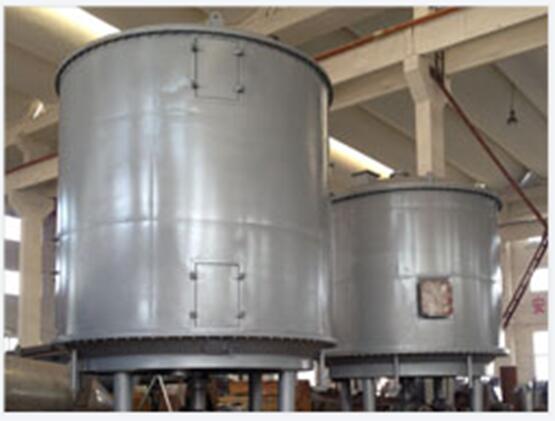
Overview
Wet material is continuously fed from the feeder onto the first drying disc at the upper part of the dryer. The rake arms with rake blades perform a rotary motion, causing the rake blades to continuously turn and move the material. The material flows along an exponential spiral path over the surface of the drying discs. On the small drying discs, the material is moved to the outer edge and falls from the outer edge onto the outer edge of the large drying disc below. On the large drying discs, the material moves inward and falls from the central discharge opening into the next layer of small drying discs. The large and small drying discs are arranged alternately above and below, allowing the material to flow continuously through the entire dryer. A heating medium is introduced into the hollow drying discs. The heating medium can be saturated steam, hot water, or thermal oil. It enters from one end of the drying disc and exits from the other end. The dried material falls from the last drying disc to the bottom of the shell and is finally moved by the rake blades to the discharge outlet. Moisture escaping from the material is discharged through the moisture exhaust outlet provided on the top cover. In a vacuum-type disc dryer, the moisture is drawn out through the vacuum pump port provided on the top cover. The dried material discharged from the bottom layer can be directly packaged. By adding auxiliary equipment such as finned heaters, solvent recovery condensers, bag filters, dry material back-mixing mechanisms, and induced draft fans, the drying production capacity can be improved. It can dry paste-like and heat-sensitive materials, conveniently recover solvents, and perform pyrolysis and reaction operations.
The disc dryer is a vertical continuous drying device based primarily on conduction heating. Its core consists of multiple layers of hollow heating discs arranged alternately above and below. During operation, wet material is continuously fed from the top feeder onto the first drying disc. The rake arms mounted on the rotating main shaft drive the rake blades to rotate, continuously turning the material and moving it forward along an exponential spiral path. On the small discs, the material is moved to the outer edge and then falls onto the outer edge of the large disc below. On the large disc, it moves toward the center and falls through the discharge opening onto the next layer of small discs, thus descending layer by layer to the bottom. During this process, a heating medium such as steam, hot water, or thermal oil is introduced into the hollow drying discs to indirectly heat the thin layer of material on the disc surface. The evaporated moisture is discharged through the moisture exhaust outlet or vacuum port at the top, and the dried finished product is discharged from the discharge outlet at the bottom.
(1) Easy regulation and strong applicability
Adjusting the material layer thickness, main shaft speed, number of rake arms, rake blade type and size can optimize the drying process.
Each layer of drying discs can be independently supplied with a hot or cold medium to heat or cool the material, allowing accurate and easy control of material temperature.
The residence time of the material can be precisely adjusted.
The material flows in a single direction without back-mixing, resulting in uniform drying and stable quality without the need for further mixing.
(2) Simple and easy operation
Starting and stopping the dryer is very simple.
After the feed is stopped, the rake blades conveying the material can quickly empty the material inside the dryer.
Through special large-size inspection doors and sight glasses, the interior of the equipment can be carefully cleaned and observed.
(3) Low energy consumption
The material layer is very thin, the main shaft speed is low, and the power required by the material conveying system is small, resulting in low power consumption.
Drying is carried out by conduction heat, featuring high thermal efficiency and low energy consumption.
(4) Good operating environment, solvent recovery, and dust emissions meeting requirements
Atmospheric type: Due to the low airflow velocity inside the equipment and the humidity distribution being high at the top and low at the bottom, dust can hardly float to the top of the equipment. Therefore, the exhaust gas discharged from the top moisture exhaust outlet contains almost no dust.
Closed type: Equipped with a solvent recovery device, it can conveniently recover organic solvents from the moisture-laden gas. The solvent recovery device is simple and has a high recovery rate. For flammable, explosive, toxic, and easily oxidized materials, nitrogen can be used as the moisture-laden gas for closed-loop circulation to ensure safe operation. It is particularly suitable for drying flammable, explosive, and toxic materials.
Vacuum type: The disc dryer operating under vacuum is particularly suitable for drying heat-sensitive materials.
(5) Easy installation and small floor space
The dryer is shipped as a whole and transported as a whole. It only needs to be hoisted into place, making installation and positioning very easy.
Due to the layered arrangement of drying discs and vertical installation, even with a large drying area, the floor space is small.
(1) Organic Chemical Products
Polyvinyl chloride (PVC) resin, polytetrafluoroethylene (PTFE) resin, fumaric acid, anthraquinone, nitroanthraquinone, p-aminophenol, melamine, cyanuric acid, p-aminobenzenesulfonic acid, antioxidant 168, naphthol AS, stearates, aniline, nitroaniline, dipentaerythritol, chlorinated paraffin, calcium formate, triethylenediamine, sodium benzenesulfinate, isophthalic acid, sodium dimethyl 5-sulfoisophthalate, thiourea, oil-soluble aniline black dye, acid black dye, and other organic chemical raw materials and intermediates.
(2) Inorganic Chemical Products
Light calcium carbonate, activated calcium carbonate, nano-grade ultrafine calcium carbonate, magnesium carbonate, aluminum hydroxide, white carbon black, strontium carbonate, barium carbonate, potassium carbonate, lithopone, sodium hydrosulfite, barium sulfate, potassium sulfate, microsphere catalyst, magnesium hydroxide, copper sulfate, nickel sulfate, nickel ammine, sodium molybdate, sodium chloride, cryolite, iron oxide red, lithium hydroxide, nickel hydroxide, zirconium hydroxide, calcium phosphate, sulfur, etc.
(3) Pharmaceuticals and Food
Ampicillin, Dane salt, L-phenylglycine and intermediates, cefotaxime, ceftriaxone, analgin, cimetidine, vitamin B12, vitamin C, pharmaceutical salts, pharmaceutical aluminum hydroxide, pharmaceutical magnesium metasilicate, caffeine, tea, flower extract, ginkgo leaf, chocolate powder, starch, corn germ, and other raw materials and pharmaceutical intermediates.
(4) Feed and Fertilizer
Potassium carbonate, biological potassium fertilizer, protein feed, feed-grade chlortetracycline, mycelium, bran, distiller's grains, grain, seeds, herbicide, cellulose, feed-grade dicalcium phosphate, etc.
Prev:Vacuum Belt Dryer
Next:Hollow Paddle Dryer

High-tech Enterprise
QMS Certified
SRMS Certified
Tel:+86-510-83382327 83382326 83390269
Mail:master@dspwgz.com
Add:eside Dengxiang Bus Station, Qianzhou Town,
Huishan District, Wuxi, Jiangsu, China.


Press & Hold to Scan,Follow our WeChat account.