Wuxi Dongsheng Spray Granulating Drying Machinery Factory! We are a seasoned professional manufacturer specializing in various types of spray dryers!
中文版
Hotline::+86-510-83382327


Overview
The liquid feed can be a suspension or an emulsion. The feed is pumped to a spray gun located inside the air distributor at the top of the tower.
The liquid is atomized into a high-speed drying air stream. The resulting atomized droplets are carried downward by the airflow toward the internal fluidized bed while being dried into particles. As the particles enter the fluidized bed, the airflow reverses and moves upward. Fine powder is discharged from the top of the drying tower, and the finer particles separated from the exhaust air are recirculated back into the drying tower body.
The fluidization of particles in the fluidized bed, the circulation of fine powder, and the movement of particles in the drying airflow occur in an air environment with a higher dust density than that of traditional drying systems. By overcoming the problem of particle surface adhesion, particles with high moisture content can be processed. The moisture content of particles entering the fluidized bed can be controlled within a certain required range, thereby achieving larger particles and structural changes (agglomeration or granulation).
When necessary, the drying and cooling of the finished product can be carried out in another external fluidized bed connected to the outlet of the internal fluidized bed.
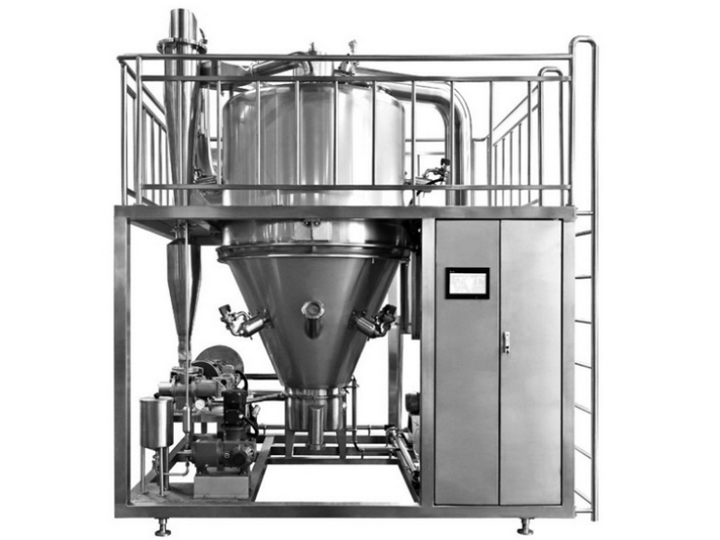
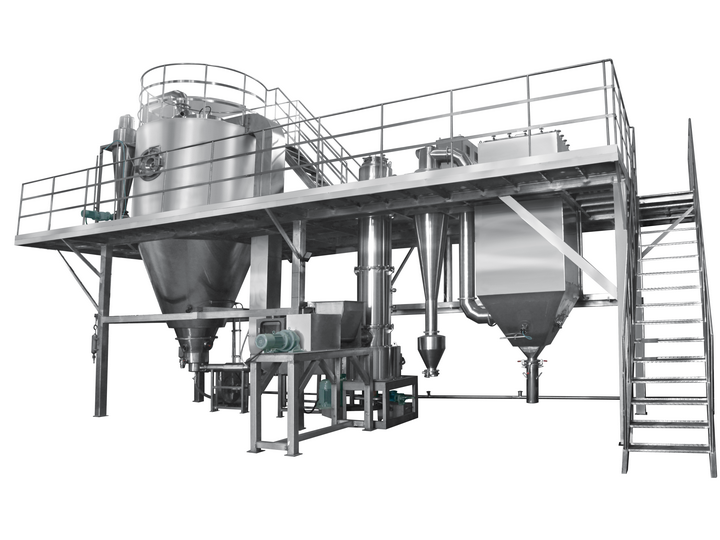
Overview
The liquid feed can be a suspension or an emulsion. The feed is pumped to a spray gun located inside the air distributor at the top of the tower.
The liquid is atomized into a high-speed drying air stream. The resulting atomized droplets are carried downward by the airflow toward the internal fluidized bed while being dried into particles. As the particles enter the fluidized bed, the airflow reverses and moves upward. Fine powder is discharged from the top of the drying tower, and the finer particles separated from the exhaust air are recirculated back into the drying tower body.
The fluidization of particles in the fluidized bed, the circulation of fine powder, and the movement of particles in the drying airflow occur in an air environment with a higher dust density than that of traditional drying systems. By overcoming the problem of particle surface adhesion, particles with high moisture content can be processed. The moisture content of particles entering the fluidized bed can be controlled within a certain required range, thereby achieving larger particles and structural changes (agglomeration or granulation).
When necessary, the drying and cooling of the finished product can be carried out in another external fluidized bed connected to the outlet of the internal fluidized bed.
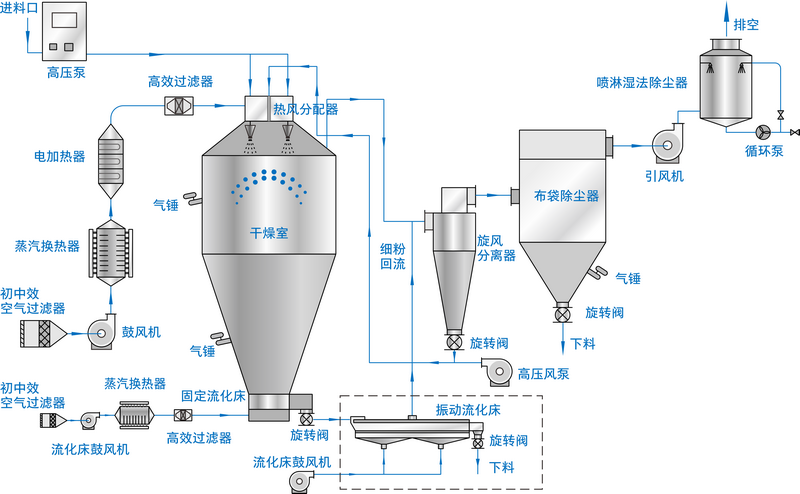
The top-exhaust spray dryer adopts a mixed-flow drying method. After the atomized feed droplets enter the tower, they move in a co-current direction with the hot air during the constant-rate drying period. When entering the falling-rate drying period, the hot air makes a 180-degree turn at the bottom of the tower, separating the drying material from the air. The hot air then rapidly moves upward and is discharged from the exhaust outlet at the top of the tower. The exhaust outlets are usually arranged in a symmetrical four-point layout to ensure even distribution of hot air inside the tower. Meanwhile, because the return air chamber is located in the high negative pressure zone at the top of the tower, the evaporation temperature is lowered under negative pressure, thereby achieving low-temperature drying.
A multi-nozzle structural design is adopted. Droplets sprayed from each nozzle collide with one another and aggregate into hollow large particles, improving the instant solubility of the product.
2. High-pressure spraying is used, ensuring full atomization of the material and sufficient contact with hot air, thereby increasing the heating area and improving thermal efficiency.
3. The air distribution device uses multiple adjustable air ducts to ensure that the airflow entering the tower moves vertically downward without deflection or vortices, reducing dust adhesion to the walls.
4. The exhaust outlet adopts a multi-outlet top exhaust design. The air reaches the bottom and makes a 180-degree turn, increasing the drying time of the material. The exhaust is uniform, reducing dust adhesion to the walls and the amount entering the cyclone separator, thereby improving product yield.
5. Fine powder from the cyclone separator enters the top of the tower and returns to the tower for agglomeration, forming larger particles and improving the instant solubility of the product.
6. The powder in the tower body enters a fixed fluidized bed from the cone, where it undergoes secondary drying, granulation, and cooling, improving product quality and solubility.
7. The cooled powder enters a vibrating screen for screening and then packaging.
Material properties particularly suitable: high fat content, poor thermal stability, thermoplastic, hygroscopic, and sticky at high moisture content; dairy products, microencapsulated flavors, coffee, non-dairy creamer, egg products, fruit and vegetable powder, seasonings, yeast, health products, protein and protein hydrolysate products, etc.; antibiotics, vitamins, enzyme preparations, blood products, sugar products, various fermentation broth products, etc.; dyes, pesticides, inorganic substances, organic substances, tannic acid, molasses, water treatment agents, etc.

High-tech Enterprise
QMS Certified
SRMS Certified
Tel:+86-510-83382327 83382326 83390269
Mail:master@dspwgz.com
Add:eside Dengxiang Bus Station, Qianzhou Town,
Huishan District, Wuxi, Jiangsu, China.


Press & Hold to Scan,Follow our WeChat account.